



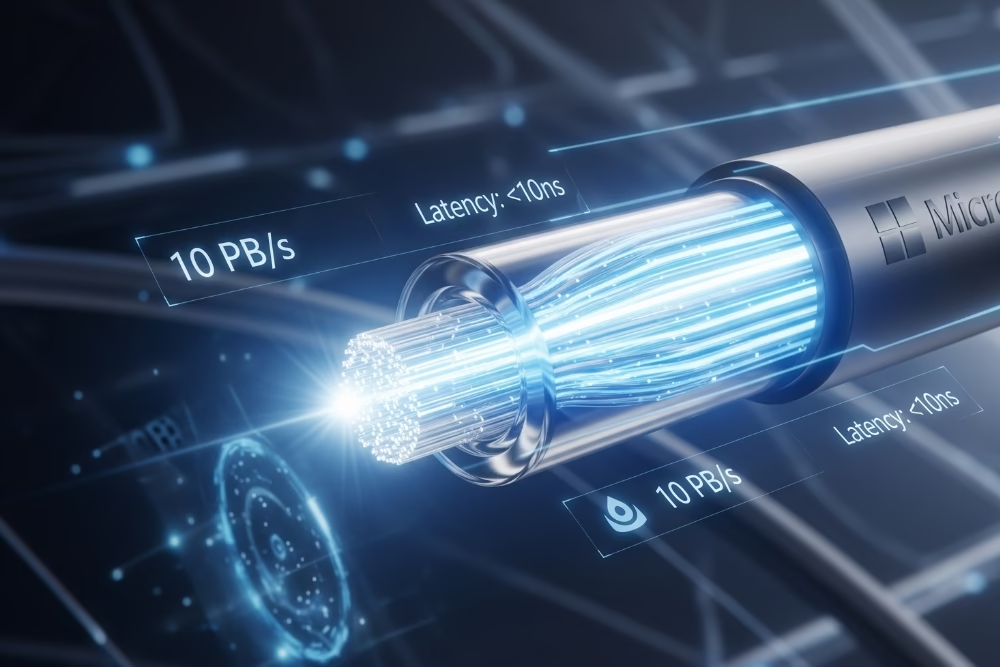
The next big transformation in internet technology may come from a glass strand with an air-filled heart. Instead of solid glass cores that dominate today’s fiber-optic cables, researchers at the University of Southampton have developed hollow-core fibers (HCF) that guide light through microscopic air channels.
By letting light travel through air rather than glass, these fibers cut energy loss and speed up data transfer. Traditional fibers lose about half their signal every 15–20 km, requiring frequent boosters. The new hollow design extends that distance to around 33 km before signal loss reaches the same point. On top of that, these fibers can handle more than 1,000 times the power of current versions and carry signals across a wider range of wavelengths. They can also transmit single-photon pulses of visible light, which are essential for quantum communications. That makes them valuable not only for today’s networks but also for future quantum systems.
Why Hollow Fibers Matter
Hollow-core technology isn’t brand new. Earlier designs were used in specialised cases like high-speed data center links. Since light travels about 45% faster through air than through glass, the advantage was obvious. The problem? Cost and complexity made large-scale use unrealistic.
That’s changing. Professor Francesco Poletti and his team at Southampton have refined this design for over a decade. The secret lies in its unique structure: a tube-like core running through the center of the fiber, which is absent in solid fibers. The fiber has rigid walls (the shell) that give it structure and form. This architecture helps light stay confined within the hollow center, reducing leakage and boosting efficiency.
Latency: The Critical Factor
To understand the importance of lower latency, think about online gaming. A high-speed, low-latency connection means your actions reach the server instantly, creating smooth, real-time gameplay. A laggy connection, however, causes delays that ruin the experience.
The same principle applies to AI systems. Whether processing speech, analysing images, or training massive models with billions of parameters, AI workloads involve constant back-and-forth communication across networks. If latency is high, performance suffers, resources are wasted, and results may be less accurate. With low latency and faster networking, AI models can train quickly, respond faster, and deliver sharper outcomes.
Enabling Real-Time AI Applications
HCF could be a game-changer for AI applications that require instant responses, including:
- Autonomous vehicles need to detect objects and make driving decisions in milliseconds.
- Smart devices that react immediately to user input.
- Video streaming and online gaming, where lag ruins the experience.
By allowing near real-time data transfers, hollow fibers give AI the speed and reliability it needs to function effectively in critical scenarios.
Challenges Ahead
- Scaling Production: Manufacturing hollow-core fibers requires new techniques and tooling, making large-scale rollout complex.
- Standardization: Industry-wide standards for hollow-core design and deployment are still being developed.
- Adoption: Transitioning from traditional silica fibers to hollow-core will take time, especially for global networks spanning thousands of kilometers.
With Microsoft’s investment and growing research interest, hollow-core fiber is no longer just a lab experiment; it’s becoming a commercial reality. Hollow-core fiber demonstrates that the future of the internet may not be glass, but air-filled pathways for light. With faster speeds, reduced latency, and improved efficiency, this technology has the potential to reshape global connectivity, enable next-generation AI, and lay the groundwork for quantum communications. For the first time, a fiber that carries light through air is not only faster but also less lossy than glass, a milestone that could mark the beginning of the next great internet revolution.
