



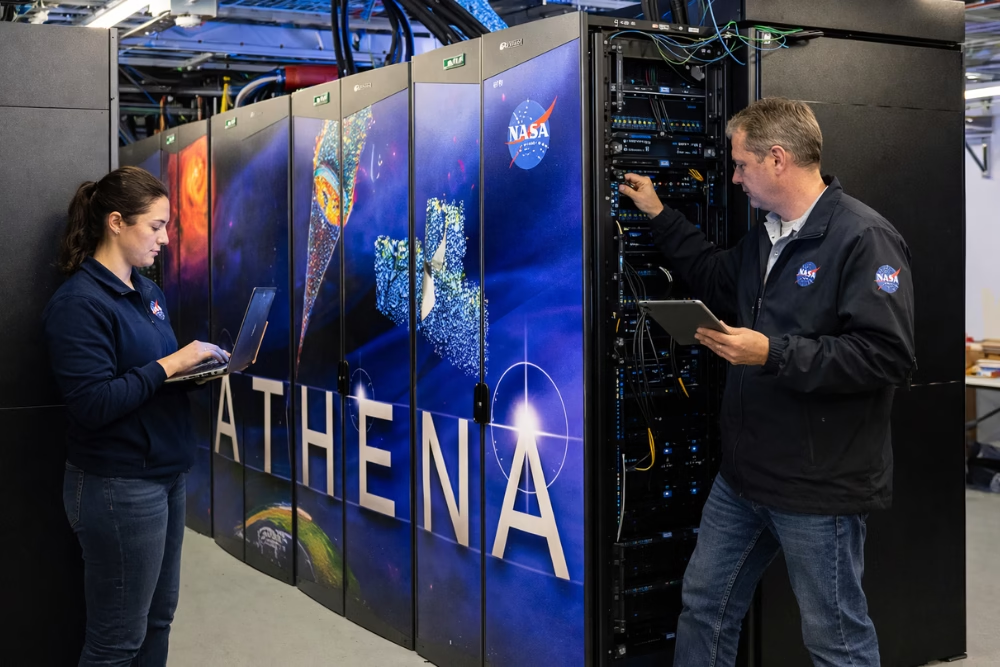
NASA continues to redefine the limits of high-performance computing with the launch of its latest supercomputer, Athena. Built to handle data-intensive simulations and advanced AI workloads, Athena represents a major leap in NASA computing technology. Athena is positioned as the most efficient supercomputer in the world, transforming both the scope and pace of research and discovery.
Designed to tackle the most complex scientific challenges, Athena will spearhead advancements in various scientific fields, from space exploration to climate modeling. As Athena comes online, it strengthens NASA’s ability to process vast amounts of data and drive faster, more accurate scientific breakthroughs.
NASA’s Supercomputing Evolution
NASA’s journey in the realm of supercomputing has been marked by several groundbreaking achievements, each iteration pushing the envelope of what machines can achieve. Over the decades, NASA has used high-performance computing to power complex simulations, data analysis, and mission-critical modeling. Early supercomputers, though powerful for their time, pale in comparison to the capabilities of today’s machines. As NASA’s missions grew in complexity, the demand for more advanced computational power surged, necessitating continuous evolution and adaptation.
In the early era of space exploration, NASA relied on mainframe systems that laid the foundation for modern scientific computing. These early machines laid the groundwork for computation, allowing NASA to process massive datasets and conduct simulations critical to mission planning and execution.
Later, dedicated NASA supercomputers such as Columbia and Pleiades dramatically expanded the agency’s ability to run large-scale simulations and data-intensive workloads. Each new addition represented a significant leap in processing capabilities, enabling more accurate and complex simulations.
With Athena, NASA not only preserves its legacy but also propels it into a future where computational ability can directly correlate with scientific discovery and innovation. As computations grow exponentially more complex, Athena stands ready, built on decades of advancements and poised to tackle the hurdles of tomorrow.
Why Athena Was Built
The decision to build Athena stemmed from a need to address increasingly complex scientific challenges that surpass the capabilities of existing supercomputers. As NASA’s missions generate larger and more complex datasets, more powerful and efficient computing became essential. Athena was designed to overcome these bottlenecks and provide unprecedented computational prowess to the scientific community.
Several key factors spurred the development of Athena:
- Processing Demand: With projects like the James Webb Space Telescope and various Mars missions, there was a surge in the need for processing power to analyze large datasets quickly and accurately.
- Advanced Simulations: Modern scientific inquiries require simulations that accurately depict complex processes such as climate patterns, astrophysical events, and spacecraft dynamics.
- Interdisciplinary Research: NASA’s initiatives often involve collaboration across multiple scientific domains, necessitating a flexible and powerful computing solution adaptable to numerous fields.
Athena ensures NASA can support next-generation research, simulations, and data-driven discovery across its missions.
Athena’s Core Capabilities
Athena’s capabilities are defined by a combination of raw computational power, advanced architecture, and adaptive algorithms designed to meet the demanding needs of varied scientific disciplines. Built with the latest technology, Athena is capable of performing quadrillions of calculations per second, making it one of the fastest supercomputers ever constructed.
Key features include:
- High-Performance Computing (HPC): Athena uses modern multi-core CPUs and accelerated computing to run large-scale simulations and data-heavy workloads efficiently.
- Energy Efficiency: Utilizing cutting-edge cooling systems and energy-efficient processors, Athena achieves maximum performance with a minimum environmental footprint.
- Data Handling: Athena supports large-scale data processing for NASA missions, enabling faster analysis of scientific and engineering datasets.
- Adaptability: Athena’s modular design allows it to be modified efficiently to incorporate new technological advancements or to be tailored for specific mission requirements.
These core capabilities empower researchers to conduct simulations and analyses with unprecedented precision, opening up new avenues for exploration and discovery.
Who Built Athena
The construction of Athena was a monumental collaboration involving some of the world’s leading technology and engineering firms. This ensemble of partners brought together expertise in computing, software development, and systems integration, each contributing vital components to Athena’s intricate architecture.
Leading the charge was a consortium led by IBM, a titan in computing technology, providing the primary hardware infrastructure through their innovative processor designs and memory solutions. The system integrates modern CPUs, accelerators, and networking technologies designed to support large-scale scientific simulations and data-intensive workloads.
NASA engineers and researchers worked closely with industry partners to validate and optimize Athena for mission-critical workloads. These institutions provided theoretical research and practical expertise that informed Athena’s design, ensuring its alignment with NASA’s diverse mission requirements. The synergy of corporate and academic contributions illustrates the broad collaborative spirit that underpinned Athena’s development, showcasing a concerted effort to push the boundaries of what supercomputing can achieve.
How Athena Advances Research
Athena’s introduction marks a new era of research capabilities, enabling scientists to push the limits of what is possible across numerous scientific domains. The supercomputer serves as a crucial tool in accelerating discoveries, enhancing the precision of research, and fostering innovation.
One of Athena’s most significant impacts is on climate research. With its ability to run high-resolution models that simulate Earth’s climate dynamics, Athena provides scientists with a deeper understanding of climate change phenomena, allowing them to predict future patterns more accurately. This ability aids in crafting effective strategies for mitigating the adverse effects of climate change.
In astrophysics, Athena enables large-scale simulations and data analysis that support studies of cosmic phenomena and space environments. Its processing capabilities also support mission planning and system testing for space explorations, providing vital insights and simulations for upcoming projects.
Athena enables faster, more detailed simulations and data-driven research, strengthening NASA’s ability to plan and execute complex missions.
NASA’s Computing Strategy
NASA’s computing strategy has consistently been an integrative component of their broader technological roadmap, ensuring that they remain at the forefront of technological advancement. Athena plays a central role in this strategy by providing the computing power needed for data-heavy simulations and mission-critical analysis.
This strategy includes several focused areas:
- Investment in Cutting-edge Technology: NASA allocates significant resources to research and development, ensuring that their computing infrastructure remains state-of-the-art.
- Collaboration with Industry Leaders: To maintain a competitive edge, NASA collaborates with leading technology firms to incorporate the latest innovations into their systems.
- Sustainability: Part of NASA’s strategy involves minimizing their environmental impact, ensuring that their computational advancements are energy-efficient.
- Cross-disciplinary Integration: Computing capabilities at NASA are designed to be versatile, supporting a wide range of fields through interdisciplinary collaboration.
By maintaining a clear focus on these objectives, NASA ensures that its computing strategy not only supports its current missions but also adapts to the evolving demands of future scientific endeavors.
Athena’s Global Impact
Athena’s launch represents not only a leap forward for NASA but also a significant contribution to global scientific and technological progress. By providing a platform capable of tackling some of the world’s most pressing challenges, Athena stands as a beacon of what can be accomplished through collaboration and innovation.
Globally, researchers in various industries benefit from NASA’s willingness to share their computational advancements and insights derived from using Athena. Whether it’s improving weather forecasting models, enhancing agricultural practices through climate monitoring, or aiding in the development of new materials, the applications are wide and varied.
Moreover, Athena serves as an educational tool, inspiring the next generation of scientists and engineers by demonstrating the power and potential of advanced computing technology. Educational programs that focus on modeling and simulation in partnership with NASA open doors for students and researchers worldwide, solidifying NASA’s role as a leader in applied scientific research and technology dissemination.
What Comes Next for NASA Computing
As Athena begins its operational journey, NASA is already looking towards the future, iterating on their computational frameworks and planning further advancements. The dynamic nature of science and technology means that NASA must continually adapt and innovate to keep pace with new discoveries and challenges.
Future plans include the integration of more potent artificial intelligence algorithms to enhance computational efficiency and the expansion of Athena’s capabilities through updated components and technology. NASA is also exploring emerging technologies, including quantum computing, for future research and development efforts.
Moreover, NASA is committed to fostering global collaboration. By integrating Athena’s advancements into broader international scientific endeavors, NASA aims to maximize the impact of its research and facilitate scientific progress on a global scale.
Projects like Athena strengthen NASA’s ability to support complex missions and long-term scientific research.
Athena reflects NASA’s ongoing investment in high-performance computing and scientific innovation. As the world’s most efficient supercomputer, it not only sets new benchmarks in computing technology but also captures the essence of what NASA strives to accomplish: to explore, to learn, and to advance human knowledge for the benefit of all.
Athena, with its remarkable capabilities and promising future, is set to be a transformative influence on how we perceive and interact with the universe.
